What Is Sky Ecosystem?
Key takeaways
- Sky Ecosystem is the whole network: Sky Protocol, the Sky Agent Network, SKY holders, contributors, and partners. It is a global capital allocation protocol powering the Sky Savings Rate, accessed through sUSDS, the world's largest yield-generating stablecoin.
- The Sky Savings Rate is set by Sky Governance and paid from Sky Protocol revenue. The largest revenue source is lending USDS to the Sky Agent Network; the protocol also earns from Stability Fees, the Peg Stability Module, and other protocol-level fee flows.
- sUSDS holders access the Sky Savings Rate; they are not exposed to any specific Agent's performance. Losses from an Agent's strategy are absorbed in a fixed order: the Agent's own risk capital, the Surplus Buffer, recapitalization through SKY issuance, and Emergency Shutdown as a last resort.
- Every USDS in circulation is backed by Protocol Collateral, and the system runs overcollateralized: $14.5B in total Protocol Collateral against $10.92B in circulating USDS at the time of writing. Every position is auditable at financial.skyeco.com.
- The core protocol has recorded zero exploits across seven years of operations, and S&P Global assigned it a B- rating in 2024, the first structured finance credit rating assigned to an onchain protocol.
Sky Ecosystem is a global capital allocation protocol powering the Sky Savings Rate, engineered for the best risk-adjusted yield on stablecoins and accessed through sUSDS, the world's largest yield-generating stablecoin.
The architecture that fuels the Sky Ecosystem can be summed up this way: Independent capital allocators, known as the Sky Agent Network, access USDS liquidity under risk parameters defined through a governance process that seeks to keep the Protocol's security at heart. Sky Protocol earns revenue from that activity and from other protocol-level fee flows. Sky Governance is in charge of setting the Sky Savings Rate against the revenue that accrues in the protocol, and the sUSDS token is the access point to the rate.
This article will cover what Sky Ecosystem is, how capital moves through it, where the rate comes from, what protects the system when something goes wrong, and how to verify every figure for yourself.
Why does so much stablecoin capital sit idle?
Sky Protocol was created to address two shifts happening in global finance.
The first is that credit, and the yield that comes with it, is moving onchain. Onchain settlement is cheaper, faster, and easier to verify than the rails most institutions have relied on for decades, and once a few serious allocators prove that out, the rest tend to follow.
The second is the stablecoin itself, which has quietly become the most useful form of fiat-pegged value much of the world can reach: programmable, borderless, settled in seconds. The stablecoin category grew roughly 50% year over year in 2025. Yet by most estimates around 80% of that supply sits idle, deployed into no source of yield at all. A fast-growing pool of stablecoins, most of it standing still.
The Sky Ecosystem as a whole (the Protocol, the Sky Agents, and all of the companies participating within) exist to bridge those gaps.
What is Sky Ecosystem, and what is it not?
What it is
Sky Ecosystem is the whole network: Sky Protocol, the Sky Agent Network, SKY holders, contributors, and partners. When analysts describe Sky as financial infrastructure rather than a single application, this is the system they mean.
What it is not
It is not a single company pulling levers behind a curtain. It is non-custodial: governance sets parameters through onchain Executive Votes, and no third party can move balances, override liquidation logic, or access collateral directly. It is not an asset manager; Sky Protocol does not manage anyone's funds. And the Sky Savings Rate is not a marketing number. It is a rate set by governance and paid from the revenue the protocol earns.
Sky Protocol, Sky Ecosystem, Sky Governance, and the Sky Frontier Foundation
Four names describe different parts of the same system. They are not interchangeable, and keeping them straight is the fastest way to understand how everything fits.
How does Sky Ecosystem work?
The original stablecoin bargain was simple. You hand an issuer your funds, they hand you a token, they invest those funds in Treasury bills, and they keep the yield. Sky Protocol runs on the opposite premise: the revenue the protocol earns funds a savings rate that any stablecoin holder can access. Three parts make that work.
Sky Protocol, the infrastructure
Sky Protocol is a global and transparent liquidity infrastructure through which independent capital allocators access USDS liquidity under governance-set risk parameters. The protocol's architecture enforces those parameters, manages liquidity flows, and automates settlement, allowing capital allocation to scale without manual intermediaries. Think of it as the plumbing and the rulebook, not the trader.
The Sky Agent Network, the largest source of protocol revenue
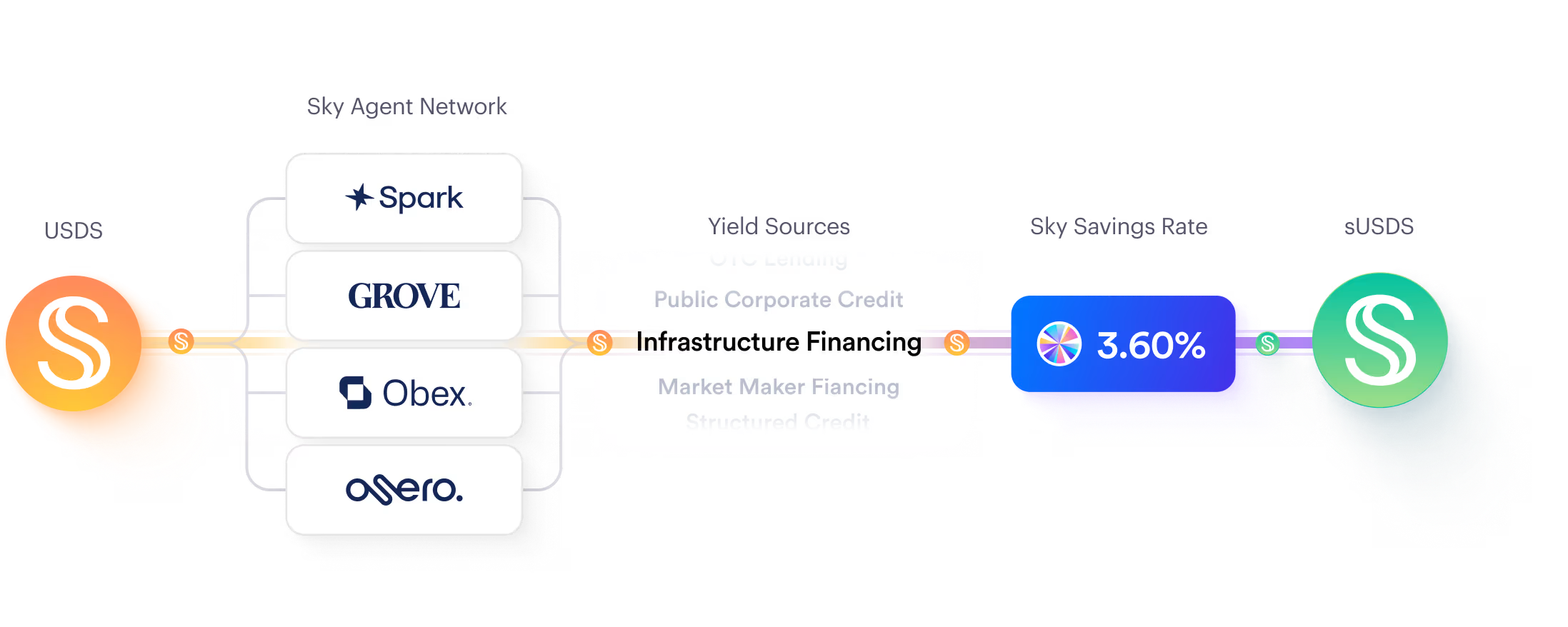
The Sky Agent Network is an independent network of capital allocators that access ready-to-deploy USDS liquidity and put it to work across diversified yield strategies: onchain lending markets, tokenized Treasuries, institutional credit, and real-world strategies such as housing finance. Raising capital is the hardest part of building a financial business, so the arrangement is clean. Sky Protocol supplies the credit facility, the Agents supply the expertise to deploy it under governance-set risk parameters, and each Agent pays a Base Rate on all USDS deployed, settled onchain monthly. Returns from these deployments contribute to Sky Protocol revenue. The Agents are independent businesses, not subsidiaries of Sky, and their performance is not a sUSDS holder exposure.
The Sky Savings Rate, and how sUSDS works
Revenue accrues at the protocol level from several sources: Stability Fees on collateralized vaults (the protocol's oldest revenue line), the Base Rate Agents pay on deployed USDS, and fees and returns from the Peg Stability Module and tokenized real-world asset positions. Sky Governance sets the Sky Savings Rate against that revenue.
Accessing the rate is one step: convert USDS to sUSDS, the world's largest yield-generating stablecoin, built for frictionless access to the Sky Savings Rate with instant liquidity. The rate is variable, set by governance, and published live at financial.skyeco.com.
Who are the Sky Agents?
.png)
How Agents compete for capital
An Agent is an independent business, and the competition between Agents is the point. How much USDS an Agent can deploy is capped by a governance-set debt ceiling; raising one requires an Executive Vote with a mandatory time delay, and no team can adjust concentration limits unilaterally. Each Agent posts risk capital proportional to its deployed exposure, calibrated by asset class using a Basel III (CRR) methodology, and those requirements evolve with the Agent's track record. Underperforming Agents must hold more capital before deploying additional USDS. Agents pay the Base Rate regardless of their returns; performance governs ceiling size and capital terms, so the best-performing Agents gain access to better collateralization rates and deploy capital more effectively.
Who is already deploying
.avif)
These are real companies moving real capital, and the positions are public. Spark runs the largest book, deploying through SparkLend with roughly $500M allocated to BlackRock/Securitize's BUIDL and more than $1B across tokenized Treasuries. Grove focuses on institutional tokenized credit, with roughly $2.7B deployed through its Basin platform and a $50M anchor position in Galaxy Asset Management's tokenized CLO. Obex, the ecosystem's Agent incubator, runs a $1B facility whose first cohort includes Better, Maple, Securitize, Centrifuge, River, and USD.ai; River has since begun transitioning to standalone Agent status. Better (NASDAQ: BETR), the digital mortgage lender, operates a $500M mortgage credit facility and is the first publicly listed US company to deploy capital as a Sky Agent. And in April 2026, Coinbase completed the migration of DAI to USDS, the largest stablecoin migration to date.
None of this requires taking anyone's word for it. Every position is auditable at financial.skyeco.com.
Where does the sUSDS yield come from?
How the rate is funded
The Sky Savings Rate is engineered for the best risk-adjusted yield on stablecoins. It is a governance-set rate paid from Sky Protocol revenue. Sky Protocol earns revenue across multiple sources, the largest of which is lending USDS to the Sky Agent Network, which deploys it across diversified yield strategies including fees from collateralized loans, US Treasury bill investments, and lending market liquidity provisioning. The protocol also earns revenue from the Peg Stability Module and other protocol-level fee flows. All of this revenue flows back into the protocol, and Sky Governance sets the parameters of the Sky Savings Rate against it.
What an sUSDS holder actually holds
Because that revenue is diversified across many sources, the rate does not live or die with any single one of them. A holder of sUSDS holds access to the Sky Savings Rate, a governance-set rate paid from Sky Protocol revenue. The holder is not a claimant on any specific collateral pool, borrower, Agent, or strategy. sUSDS holders access the rate; they are not exposed to any specific Agent's performance. That distinction is structural, and it is the part most people get backwards.
What happens if a Sky Agent fails?
The question anyone serious asks next is what happens when a strategy goes wrong. Sky Protocol answers it structurally rather than with reassurances.
Four layers of loss absorption
If an Agent's strategy takes losses, those losses are absorbed in a fixed, predetermined order. First, the Agent's own risk capital, held proportional to its deployed exposure and calibrated by asset class, absorbs any shortfall before the protocol takes any loss. Second, the Surplus Buffer, where protocol revenue accumulates before distribution; in May 2026, Sky Governance raised its target to $150M USDS to accelerate this reserve. Third, governance can authorize recapitalization through SKY token issuance, which requires an Executive Vote with a mandatory time delay. Fourth, as a last resort, Emergency Shutdown halts all USDS minting and lets every USDS holder redeem directly against the remaining collateral pool at the then-current ratio, preserving collateral access even under complete governance failure.
Overcollateralization and structural controls
Every USDS in circulation is backed by Protocol Collateral, and the system runs overcollateralized: $14.5B in total Protocol Collateral against $10.92B in circulating USDS at the time of writing, spread across the Peg Stability Module (roughly 38%), Sky Agent vaults (roughly 40%), and overcollateralized crypto vaults (roughly 22%), with Sky Reserves as an additional buffer. The controls run deeper than the balance sheet. All price data waits one hour in the Oracle Security Module before taking effect, which means a manipulation attack must sustain a false reading for over an hour under governance observation. Undercollateralized vaults are liquidated through descending-price Dutch auctions. And no sensitive parameter change takes immediate effect after a governance vote; the Governance Security Module enforces a delay on every one. All of it is visible at financial.skyeco.com.
Track record and external validation
This architecture has operated through real market stress. It remained solvent through Black Thursday in March 2020, when ETH fell more than 60% in hours. It carried zero exposure to the UST collapse and the FTX bankruptcy, because governance had never approved either as eligible collateral. It held through the SVB bank run in March 2023, when brief USDC depeg pressure reached the Peg Stability Module and the peg was fully restored without an emergency. Across seven years of team operations, the core protocol has recorded zero exploits.
The outside world has started to score it on traditional terms as well. S&P Global assigned the protocol a B- rating in 2024, the first structured finance credit rating assigned to an onchain protocol (full report). Critical contracts are under ongoing review by Certora, ChainSecurity, and Cantina. And the growth is reported quarterly: per the Sky Frontier Foundation's Q1 2026 report, Gross Protocol Revenue reached $123.79M, the highest in protocol history.
USDS, sUSDS, and SKY in plain terms
Three tokens come up constantly, and they are easy to keep straight once you see what each one does.
Who governs Sky Protocol, and who publishes its data?
Sky Governance
Sky Governance is the decision-making process: SKY token holders voting onchain on the parameters that run the protocol, including the risk limits Agents operate within and the Sky Savings Rate itself. Every protocol change ships as a Spell, a smart contract that bundles parameter changes into a single atomic transaction and passes a dual-reviewer checklist before governance votes on it, with a public audit trail. Governance sets the rules. It does not run the Agents, who choose their own strategies inside those rules.
The Sky Frontier Foundation
The Sky Frontier Foundation is the independent foundation that supports Sky Ecosystem and publishes its reporting, including quarterly reports on protocol revenue, collateral composition, the Surplus Buffer, and Agent Network performance. When a formal figure carries the ecosystem's name, the Foundation put its name to it.